- Visitors
- Researchers
- Students
- Community
- Information for the tourist
- Hours and fees
- How to get?
- Visitor Regulations
- Virtual tours
- Classic route
- Mystical route
- Specialized route
- Site museum
- Know the town
- Cultural Spaces
- Cao Museum
- Huaca Cao Viejo
- Huaca Prieta
- Huaca Cortada
- Ceremonial Well
- Walls
- Play at home
- Puzzle
- Trivia
- Memorize
- Crosswords
- Alphabet soup
- Crafts
- Pac-Man Moche
- Workshops and Inventory
- Micro-workshops
- Collections inventory
- News
- Students
- 3D Technology Reveals the Face of Ancient Peruvian Female Leader
News
CategoriesSelect the category you want to see:
PUCP Archaeology Students Visit the El Brujo Archaeological Complex ...
The Republican Settlements of El Brujo: Notes for the Recent History of Magdalena de Cao ...
To receive new news.
By:
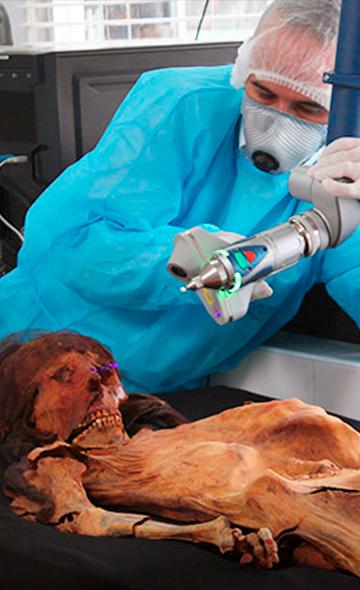
FARO’s 3D Laser Scanning Technology used in reconstructing the face of a mysterious mummy, known as the Lady of Cao. She is believed to be a female leader of the Moche Civilization in Peru, which ruled more than 1,700 years ago.
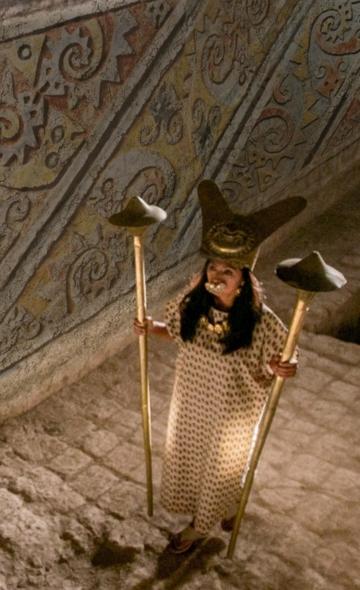
Moche culture flourished approximately a thousand years before the Inca civilization in northern Peru. In 2005, a tomb was discovered in a mud-brick ruined pyramid near Trujillo, a city on the northwest coast of Peru known for being a site of the prehistoric Moche culture. Inside of it was found an intriguing bundle of cloth. This bundle preserved a mummified female body covered in elaborate tattoos, of snakes, spiders and supernatural motifs, along with jewelry, ornaments, crowns, and two scepters. This woman is now known as “The Lady of Cao”, only known female leader of the Moche Civilization.
The Lady of Cao mummy is currently in display in the Museum of “El Brujo” Archaeological Complex, near to Magdalena de Cao town, in northern Peru. To preserve the mummy, she’s kept in a climate-controlled chamber and can only be viewed indirectly with the aid of a viewing window and mirror.
Wiese Foundation, the entity that sponsors the Museum, wanted the visitors to be able to admire the Lady of Cao more freely, and also to have a permanent digital record of her remains, to preserve them. The solution was to contact FARO. Through FARO’s state-of-the-art 3D technology, it was possible to build a 3D digital model of the mummy, 3D print a replica, and, using specialized software and forensic anthropology techniques, perform the facial reconstruction that would reveal to the world, for the first time, The Lady of Cao’s face.
To achieve this goal, FARO and Wiese Foundation, along with 3D Systems, Grupo Abstract and ARQ 3D+, assembled an international team of experts formed by archaeologists, anthropologists, forensic scientists, dentists and 3D technology engineers.
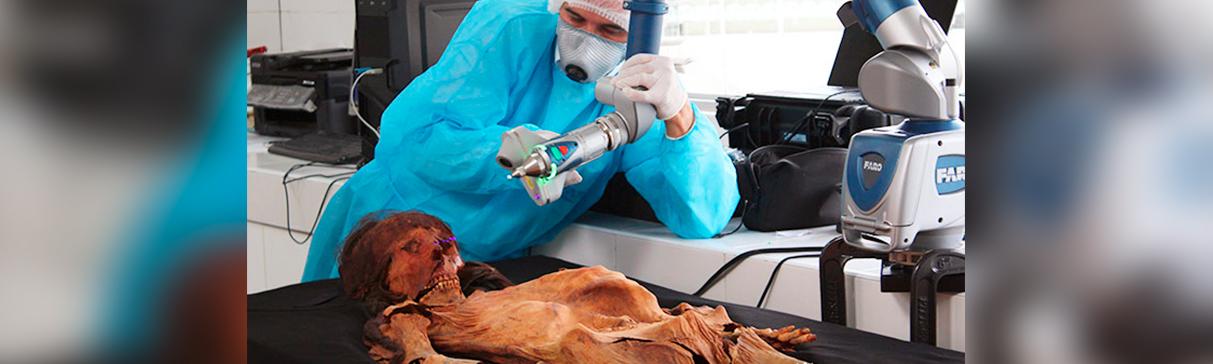
The process began with the mummy’s scan, using the FARO® Forensic ScanArm Solution, a portable 3D scanning solution tailored for forensic anthropology, crime lab, and medical examination applications. This solution consists in a FARO Design ScanArm complemented with 3D Systems’ Geomagic®Wrap and Geomagic ®Freeform® software. The FARO Freestyle3D Objects, a top-quality, high-precision, handheld scanner was also used.
FARO Design ScanArm is a portable 3D scanning solution tailored for 3D modeling, reverse engineering, and CAD-based design applications. It features optically-superior blue laser technology and red laser, which after being projected on any surface and in this case the skull of the Lady of Cao is sensed by a camera that allows to translate thousands of points in the space to the computer. By passing the laser light onto the skull the software in conjunction with the scanner generates a 3D model on the computer.
In addition to the scanning, forensic artists and anthropologists used photographs and anthropological investigations of the people in the region and Moche Civilization descendants to generate hand-drawn sketches of the initial features of the face of the Lady of Cao.
After obtaining the point cloud, the experts processed the information using Geomagic Wrap to convert the points in polygons, creating the 3D model. Once the 3D model was created, it was exported to Geomagic Freeform Plus, where the facial reconstruction was performed. With a special device, the reconstructionist “digitally sculpted” the face’s muscles, eyes, nose, mouth and skin on the virtual skull. In this stage of the process, the specialist worked with a multidisciplinary team of anthropologists, forensics artists and dentists which contributes with their expertise to the facial reconstruction.
Once the Lady of Cao’s virtual face was finished, the team proceeded to add texture, color, and finishing details such as pores, wrinkles, expression, details in lips, eyes, forehead, eyebrows, and other facial expression lines, as well as the hair.
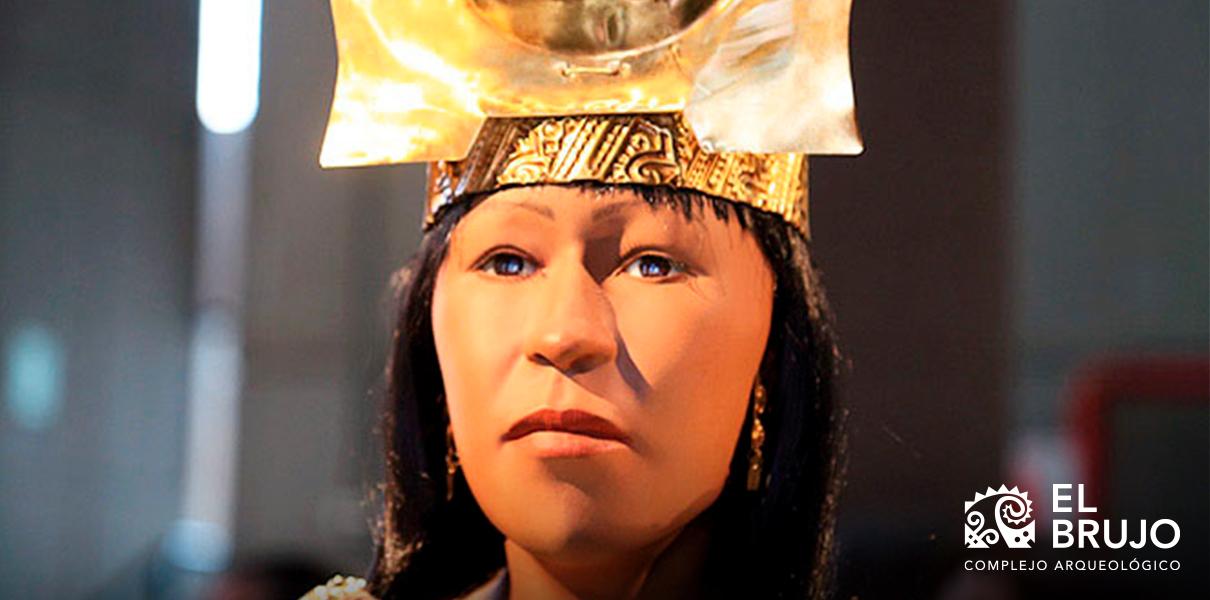
For finishing the skin and hair, the team consulted a photograph gallery of women of region, as well as ethnographic research documents.
Thanks to this effort of this multidisciplinary talent and state-of-the-art 3D technology, the face of this remarkable character of pre-Hispanic culture has been brought to life and revealed to the world.
Students , outstanding news