- Visitors
- Researchers
- Students
- Community
- Information for the tourist
- Hours and fees
- How to get?
- Visitor Regulations
- Virtual tours
- Classic route
- Mystical route
- Specialized route
- Site museum
- Know the town
- Cultural Spaces
- Cao Museum
- Huaca Cao Viejo
- Huaca Prieta
- Huaca Cortada
- Ceremonial Well
- Walls
- Play at home
- Puzzle
- Trivia
- Memorize
- Crosswords
- Alphabet soup
- Crafts
- Pac-Man Moche
- Workshops and Inventory
- Micro-workshops
- Collections inventory
- News
- Researchers
- Jewels and Ornaments of the Lady of Cao: The Diadems
News
CategoriesSelect the category you want to see:
Elite Moche Burial at Huaca Cao Viejo: The Principal Priest ...
Tumbas de élite mochica en Huaca Cao Viejo: la cámara decorada Moche Elite Tombs at Huaca Cao Viejo: The Decorated Chamb ...
To receive new news.
By: Yuriko Garcia Ortiz
The Moche people complemented their attire with a wide variety of jewels and ornaments, distinguished by their diverse shapes, sizes, designs, and raw materials. This reflects a complex social organization (Donnan, 2004). Their headdresses included turbans, crowns, masks, and diadems worn on the head, identified in the material culture through iconography and funerary contexts.
Diadems are ornaments worn across the forehead, often attached to crowns (Gayoso, 2011). They are closely associated with the reinforcement of social status, as they highlighted individuals within a group, distinguishing them by rank, gender, age, profession, or other attributes (Benda-Weber, 2014: 96).
The Lady of Cao’s Diadems
Following the discovery of the Lady of Cao in 2005, the unwrapping process documented the objects placed during her burial. Layer 5—one of the richest in funerary offerings—revealed an impressive array of artifacts with elaborate ornaments of gold, silver, and cotton used in textile production (Fernández, 2021).
Among the most outstanding pieces were four diadems, placed at the upper section of the funerary bundle as offerings. They were found beneath a mantle with gilded copper plaques (BTX00000-12), arranged one on top of the other, and covered by another mantle embroidered with a human face and earrings.
.jpg)
Figure 1. Drawing of the arrangement of the crowns by Segundo Lozada. Tomb 3 / Individual 1, layer 5. CAEB Archives. Raw materials, manufacturing, decoration, and finishing.
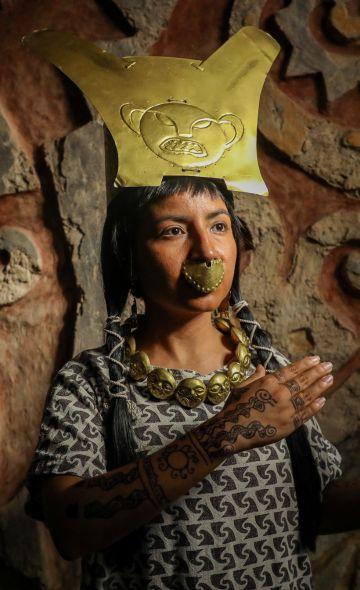
Each diadem, crafted in gilded copper, displays a distinctive “V” shape, with long rounded appendages at the upper ends, straight extensions at the lower ends, and a complex zoomorphic design at the center of the metallic piece—always with exposed fangs.
The almond-shaped eyes are a recurrent feature in the Lady of Cao’s diadems, evoking feline traits that give them a fierce appearance. Some designs also include volutes or wavy forms, such as piece EBBME00000-70 (surrounding the face) and piece EBBME00000-71 (over the mouth) (Fernández, 2021).
These ornaments were produced through carefully selected metallurgical techniques, as artisans knew and exploited the properties of metals and alloys to create unique objects (Fraresso, 2008: 155). Manufacturing methods included hammering, perforation, and cutting, while decorative techniques such as chiseling, incision, repoussé (used to shape the central design, appendage details, and circular openings), and polishing were applied as finishing touches.
.jpg)
Figure 2. Diadems of the Lady of Cao. CAEB Photographic Archive.
In the lower appendages and central sections—between the upper extensions—two repoussé designs stand out: lunar animals and life fish. These motifs also appear on the painted walls of the mausoleum at Huaca Cao Viejo, linking the diadems to the broader symbolic universe of Moche iconography.
.jpg)
Figure 3. Similarities between the decoration of the diadems and the iconography of the mausoleum chamber: east wall and battlemented wall, respectively.
Iconographic Recurrences
Iconography is key to identifying the roles of high-status individuals in Moche society, as it highlights distinctive attributes such as clothing, ornaments, ritual objects (cups, clubs, shields), ceremonial scenes, and depictions of daily life (Franco & Gálvez, 2010: 88).
A stirrup-spout bottle from the Larco Museum portrays a Moche sacrifice ceremony led by four central figures. In this scene, the elites, through their regalia, embodied the supreme deities of the Moche world. Research by Donnan (1976, 1978), McClelland (1999), and Castillo & Donnan (2000) associated specific characters—labeled A and D—with elite burials at Huaca Rajada and Huaca Cao Viejo. Among their most representative ornaments were diadems (Franco & Gálvez, 2010: 89).
.jpg)
Figure 4. Pictorial stirrup-spout bottle from the Larco Museum. Catalog code: ML010847. Scene of the Moche “presentation” or “sacrifice” (Donnan, 2004: 116). A: Lord of Sipán; D: Lady of Cao.
Diadems in Moche Elite Burials
Diadems were fundamental elements in Moche elite funerary ensembles. They played a crucial role in ritual practice and in symbolizing the social status of individuals, while displaying a wide repertoire of forms.
In the royal tombs of the Lord of Sipán at Huaca Rajada, in the Lambayeque Valley, diverse gold ornaments were uncovered, with the crescent-shaped diadem as the most emblematic piece (Alva & Donnan, 1993: 106).
Meanwhile, elite burials at Huaca El Pueblo in the Zaña Valley (Bourget, 2014) yielded more than ten gold and silver diadems, featuring anthropomorphic and zoomorphic designs extending toward the appendages and lower ends. Similarly, Donnan (2022) reported, based on looted artifacts from La Mina in the Jequetepeque Valley, diadems decorated with representations of animals such as owls (birds), iguanas (reptiles), and felines, among others.
.jpg)
Figure 5. Diadems found in the main funerary contexts of the huacas in the La Libertad region: Huaca Rajada (Alva & Donnan, 1993), El Pueblo (Bourget, 2014), and La Mina (Donnan, 2022).
References
Alva, W. & Donnan, C. (1993). Tumbas Reales de Sipán. University of California Press.
Benda-Weber, B. (2014). Non-Greek Headdresses in the Greek East. In C. Alfaro, J. Ortiz, & M. Antón (Eds.), Tiarae, Diadems and Headdresses in the Ancient Mediterranean Cultures: Symbolism and Technology (pp. 95–114).
Bourget, S. (2014). Les rois mochica: Divinité et pouvoir dans le Pérou ancien. EVERGREEN.
Castillo, L., & Donnan, C. B. (2000). La ceremonia del sacrificio mochica, en el Museo Arqueológico Rafael Larco Herrera. Revista de Arqueología, 11(232), 54–61.
Donnan, C. B. (1976). Moche Art and Iconography. UCLA Latin American Center Publications.
Donnan, C. B. (1978). Moche Art of Peru: Pre-Columbian Symbolic Communication. Museum of Cultural History.
Donnan, C. B. (2004). Moche Portraits from Ancient Peru. University of Texas Press.
Donnan, C. B. (2022). La Mina: A Royal Moche Tomb. University of New Mexico Press.
Fernández, A. (2021). Apertura de fardos funerarios. In A. Bazán (Ed.), El contexto funerario de la Señora de Cao (pp. 116–187). Fundación Wiese.
Fraresso, C. (2008). El «sistema técnico» de la metalurgia de transformación en la Cultura Mochica. Actas del I Congreso Internacional de Jóvenes Investigadores de la Cultura Mochica.
Franco, R., & Gálvez, C. (2010). Muerte, iconografía e identificación de roles de personajes de la élite mochica en Huaca Cao Viejo. Arqueología y desarrollo, 5, 79–102.
Gayoso-Rullier, H. L. (2011). Los últimos artesanos de la ciudad de barro [Doctoral Thesis]. Universidad Pablo de Olavide, Sevilla.
Researchers , outstanding news