- Visitors
- Researchers
- Students
- Community
- Information for the tourist
- Hours and fees
- How to get?
- Visitor Regulations
- Virtual tours
- Classic route
- Mystical route
- Specialized route
- Site museum
- Know the town
- Cultural Spaces
- Cao Museum
- Huaca Cao Viejo
- Huaca Prieta
- Huaca Cortada
- Ceremonial Well
- Walls
- Play at home
- Puzzle
- Trivia
- Memorize
- Crosswords
- Alphabet soup
- Crafts
- Pac-Man Moche
- Workshops and Inventory
- Micro-workshops
- Collections inventory
- News
- Students
- The 44 Nose Ornaments of the Lady of Cao at El Brujo (La Libertad, Peru): Emblems of Power and Moche Duality
News
CategoriesSelect the category you want to see:
Elite Moche Burial at Huaca Cao Viejo: The Principal Priest ...
Tumbas de élite mochica en Huaca Cao Viejo: la cámara decorada Moche Elite Tombs at Huaca Cao Viejo: The Decorated Chamb ...
To receive new news.

By: Complejo arqueológico El Brujo
In 2005, during excavations at Huaca Cao Viejo within the El Brujo Archaeological Complex, the funerary context of the Lady of Cao was uncovered, revealing one of the most important rulers of Moche society.
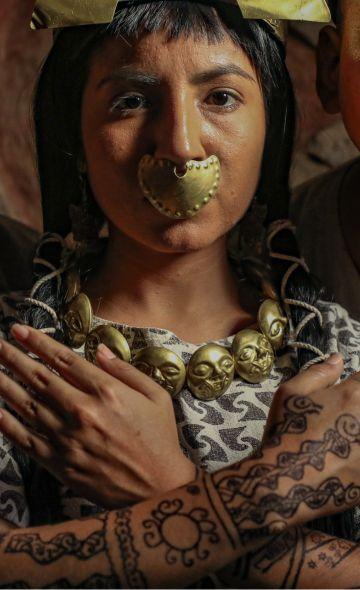
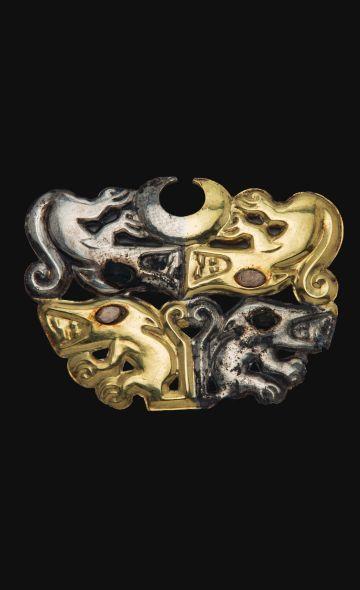
Among the most remarkable objects in her funerary assemblage were 44 nose ornaments made of gold, silver, and tumbaga, considered one of the most sophisticated goldsmithing collections from the pre-Hispanic northern coast of Peru.
These pieces not only demonstrate exceptional metallurgical mastery, but also hierarchy and a sophisticated support system for Moche power discourse.
What were nose ornaments in Moche culture and what did they symbolize?
Nose ornaments were metallic nasal adornments worn by high-ranking individuals in Moche society. They formed part of elite attire alongside diadems, crowns, clubs, and earrings.
Crafted in gold, silver, copper, or tumbaga, they functioned as:
- Insignias of power
- Emblems of political and ritual authority
- Representations of natural and supernatural beings central to ideological discourse
Their use was restricted to the aristocracy, reinforcing the exceptional social position of the Lady of Cao. (Vetter and Carcedo, 2021; Bazán, 2021)
How were the 44 nose ornaments found in the Lady of Cao’s tomb?
The tomb measured 3. 30 m long, 1. 45 m wide, and 2. 51 m deep. The body was wrapped in a funerary bundle composed of 22 textile layers.
Archaeologists recorded the discovery of:
- 42 nose ornaments wrapped in cotton textiles beside the head
- 2 folded nose ornaments placed inside her mouth
This arrangement suggests a specific ritual order within the Moche funerary context. (Bazán, 2021; Franco, 2008; Alva, 2024)
What role did the nose ornaments play in the Lady of Cao’s political power?
Research suggests these objects functioned as formal insignias of authority.
The small size of some ornaments has led scholars to propose that the Lady of Cao may have worn them from an early age, reinforcing her social status within the hierarchical Moche structure.
These nose ornaments were not simple adornments: they were visible symbols of political and religious legitimacy. (Bazán, 2021; Castillo et al. , 2008)
What metallurgical techniques did Moche goldsmiths use?
The nose ornaments were produced using advanced techniques such as:
- Hammered sheet metal work
- Cutting
- Openwork piercing
- Repoussé
- Soldering
- Gilding
- Stone and shell inlay
Alloys such as tumbaga were used to control oxidation and enhance shine. Components were joined through silver- and copper-based soldering alloys.
These techniques demonstrate an advanced level of metallurgical knowledge on the pre-Hispanic northern coast of Peru. (Bazán, 2021; Vetter and Carcedo, 2021)
What iconography is represented in the Lady of Cao’s nose ornaments?
The imagery centers on duality and complementarity, fundamental concepts in the Moche worldview.
The figures represented include:
- Warriors holding clubs
- The Decapitator deity
- Bound prisoners
- Felines
- Double-headed serpents
- Iguanas
- Scorpions
- Shrimp
- Sea lions
Zoomorphic beings frequently flank anthropomorphic figures, articulating within ideological discourse the importance of the natural environment, power, and violence. (Bazán, 2021; Franco, 2008)
Why are the 44 nose ornaments unique in the archaeology of northern Peru?
This collection of 44 nose ornaments constitutes one of the most important discoveries of Moche metalwork in the Chicama Valley.
Their preservation within an intact archaeological context is one of the few such cases recorded in Andean archaeology.
Their quantity, iconographic diversity, and technical complexity reveal:
- Specialized production
- Control of metal resources
- Regional exchange networks
The archaeological context and these objects consolidate El Brujo Archaeological Complex as one of the leading archaeological references in northern Peru.
In summary
The Lady of Cao’s nose ornaments represent two fundamental aspects for understanding Moche society:
- The presence of specialists dedicated to producing distinguished objects that reinforced social differences within the Moche hierarchy.
- The use of diverse natural and supernatural representations as part of Moche power discourse.
Beyond their aesthetic value, these pieces constitute direct evidence of hierarchy, technical knowledge, and ideological complexity in the pre-Hispanic world.
If you would like to see these objects, you can visit them in Room 6 of the site museum at the El Brujo Archaeological Complex in the La Libertad region.
Students , outstanding news