- Visitors
- Researchers
- Students
- Community
- Information for the tourist
- Hours and fees
- How to get?
- Visitor Regulations
- Virtual tours
- Classic route
- Mystical route
- Specialized route
- Site museum
- Know the town
- Cultural Spaces
- Cao Museum
- Huaca Cao Viejo
- Huaca Prieta
- Huaca Cortada
- Ceremonial Well
- Walls
- Play at home
- Puzzle
- Trivia
- Memorize
- Crosswords
- Alphabet soup
- Crafts
- Pac-Man Moche
- Workshops and Inventory
- Micro-workshops
- Collections inventory
- News
- Students
- Cinnabar: The Mineral That Preserved the Lady of Cao?
News
CategoriesSelect the category you want to see:
Elite Moche Burial at Huaca Cao Viejo: The Principal Priest ...
Tumbas de élite mochica en Huaca Cao Viejo: la cámara decorada Moche Elite Tombs at Huaca Cao Viejo: The Decorated Chamb ...
To receive new news.
By: Complejo arqueológico El Brujo
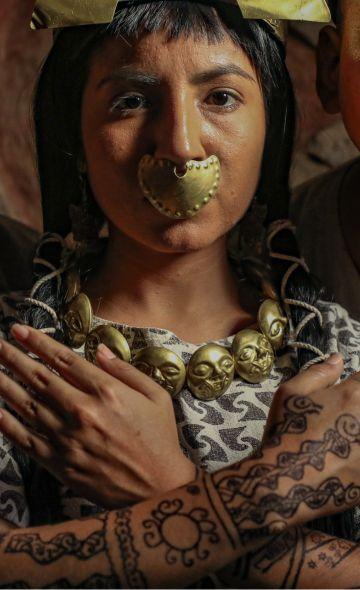
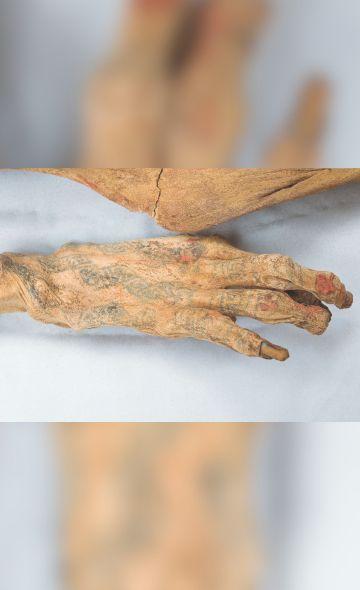
In 2005, the discovery of the funerary context of the Lady of Cao at Huaca Cao Viejo, within the El Brujo Archaeological Complex, revealed a remarkable state of preservation of her body, hair, and skin.
Among the identified elements, the presence of a red pigment stood out: cinnabar. Its use in different parts of the burial has raised the question of whether, in addition to its ritual value, it may have influenced the preservation of the body.
What is cinnabar?
Cinnabar is a mineral composed of mercury sulfide (HgS). To be used as a pigment, it had to be ground and processed. It is a relatively rare material in nature and has particular properties:
- It can darken when exposed to light and regain its tone in low-light conditions.
- When exposed to heat, it transitions from a solid to a gaseous state.
- In its solid state, it is relatively stable, but handling it involves risks.
These characteristics made it a valuable, symbolic, and exclusive pigment, which led to its use primarily by elites. There is ancient evidence of its use. For example, it has been found in funerary contexts in Teotihuacán (Mexico), in Lambayeque where it has been identified on gold masks, and in the murals of the Moche society at Pañamarca, dating to the Early Intermediate Period (200 BCE–600 CE).
The discovery at Huaca Cao Viejo
The discovery of the Lady of Cao transformed our understanding of the Moche world. Her body, hair, and skin showed an unusual state of preservation for a burial approximately 1, 500 years old.
During the excavation, traces of red pigment were identified beneath the gilded copper bowl that covered her face. Samples were sent to the US Geological Survey in Reston, Virginia, where they were confirmed to be mercury sulfide—cinnabar. This red pigment must have been processed for application as part of the funerary preparation, as elemental mercury residues were observed in the connective tissue of the epidermis. Additionally, cinnabar was used to cover and consecrate the textile layers of the Lady of Cao’s funerary bundle.
The use of cinnabar in the funerary ritual
The pigment did not appear in isolation; it was part of a complex ritual preparation.
In the funerary bundle
The outer layer of the funerary bundle was completely covered with cinnabar on its front side. Among the textile folds, tufts containing cotton seeds stained red (cinnabar) were recovered, suggesting it was carefully applied during the wrapping process.
Traces of the pigment were identified in multiple textile layers, indicating a systematic and deliberate treatment. It was not merely decorative, but a visual consecration of the body.
On the body and associated objects
Cinnabar was also recorded:
- In the hair of the Lady of Cao.
- In the epidermal tissue, where traces of elemental mercury were detected.
- On an anthropomorphic face with almond-shaped eyes embroidered on the funerary bundle, covered with the same pigment.
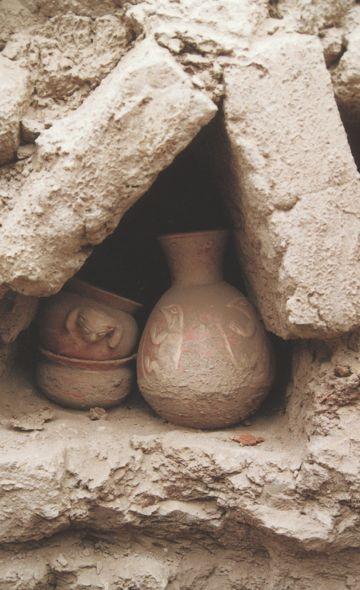
- On ceramics associated with the funerary context.
- In a layer of ash linked to a ritual burning near the burial pit.
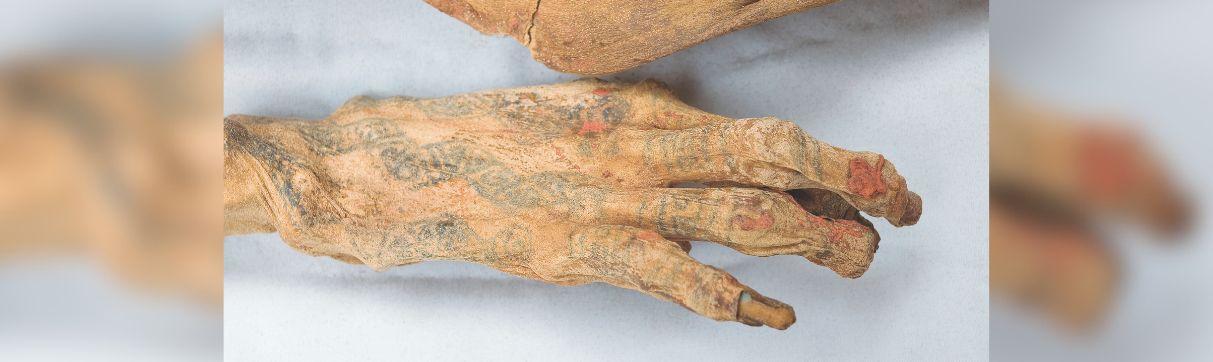
It is important to note that the visible tattoos on her body were not made with cinnabar, but with a bluish-black iron oxide. This demonstrates that the red mineral had a specific use within the ritual.
Did cinnabar preserve the body of the Lady of Cao?
The presence of cinnabar powder raises a logical question: did it contribute to preservation? From a chemical perspective, mercury has antimicrobial properties. In a closed environment with low humidity, cinnabar powder may have limited the proliferation of bacteria and fungi.
However, studies promoted by Fundación Wiese indicate that the primary preservation factor was environmental. The tomb was:
- Far from the water table.
- Isolated from rainwater infiltration.
- In relatively low-humidity conditions.
Therefore, although the mineral may have had a complementary effect, there is no conclusive evidence identifying it as the direct cause of preservation.
Risks and specialized handling
The extraction, grinding, and application of cinnabar involved exposure to mercury. Today, it is known that inhalation of its vapors can affect the central nervous system.
This suggests that its preparation was likely carried out by ritual specialists. Not just anyone handled this pigment. Its use was associated with technical knowledge, symbolic control, and political power.
Cinnabar in other funerary contexts
The use of cinnabar was not exclusive to the burial of the Lady of Cao. Evidence has been recorded in other contexts, such as in the Lambayeque Valley, where the mineral was found as part of the funerary assemblage of the Priestess of Chornancap, buried between the 12th and 13th centuries CE.
These findings reinforce the idea that cinnabar was a significant material in various pre-Hispanic cultural practices. In the case of the Lady of Cao, it is important to distinguish it from the pigment used for her abundant tattoos, which was identified as bluish-black iron oxide. Therefore, this was a special resource, likely handled by a limited group of individuals for funerary purposes linked to ruling elites.
Students , outstanding news