- Visitors
- Researchers
- Students
- Community
- Information for the tourist
- Hours and fees
- How to get?
- Visitor Regulations
- Virtual tours
- Classic route
- Mystical route
- Specialized route
- Site museum
- Know the town
- Cultural Spaces
- Cao Museum
- Huaca Cao Viejo
- Huaca Prieta
- Huaca Cortada
- Ceremonial Well
- Walls
- Play at home
- Puzzle
- Trivia
- Memorize
- Crosswords
- Alphabet soup
- Crafts
- Pac-Man Moche
- Workshops and Inventory
- Micro-workshops
- Collections inventory
- News
- Students
- The Moche Ear Ornaments of the Lady of Cao: Art and Iconography in Goldwork
News
CategoriesSelect the category you want to see:
Cinnabar: The Mineral That Preserved the Lady of Cao? ...
PUCP Archaeology Students Visit the El Brujo Archaeological Complex ...
To receive new news.

By: Complejo arqueológico El Brujo
The discovery of the Lady of Cao’s tomb (2005) at the Huaca Cao Viejo, located within the El Brujo Archaeological Complex (La Libertad), enabled the scientific documentation of a Moche elite woman in an exceptional state of preservation. Among the objects that accompanied the burial, a pair of Moche ear ornaments stands out for their aesthetic and technical complexity. What do these ornaments reveal about the culture that created them?
Beyond their beauty, these ear ornaments allow us to closely observe the mastery of Moche goldsmiths in every detail of the funerary objects. Below, we explore the value of these pieces, focusing on their craftsmanship, iconography and the context in which they were found.
A Craft of Precision: Design and Technique in the Moche Ear Ornaments
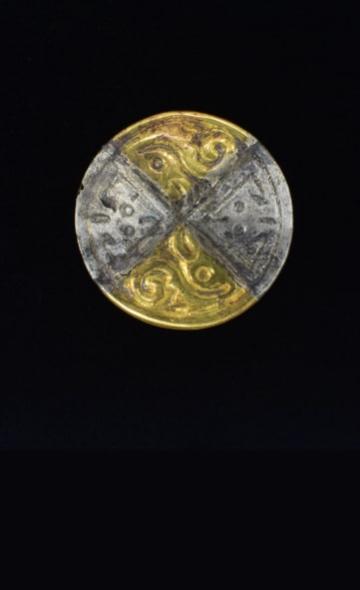
The Moche ear ornaments found alongside the body of the Lady of Cao are disc-shaped and feature bimetallic craftsmanship, combining gold and silver. On the obverse, their surface displays a low-relief decoration with a double X-shaped line dividing the disc into four quadrants.
In two of these segments appears the stylized head of a stingray; in the other two, a bird’s head with a body that ends in a wave-stair motif. On the reverse of both pieces, a thin tubular shaft is present, which allowed their insertion into the earlobe.
Motifs represented in the ear ornaments: fish, birds, and figures associated with ceremonial murals
The motifs represented on the Moche ear ornaments were not chosen at random. The stingray and the wave-stair design are associated with natural elements that played a prominent role within the ideological discourse of their time. In parallel, these same symbols are also observed in the murals of the ceremonial chamber where the Lady of Cao was buried (Tomb 3), suggesting a reiteration of representations between personal objects and the exclusive architectural space.
This type of shared design reveals how Moche art relied on repetitive visual repertoires, deeply imbued with meaning, whose iconography went far beyond decoration. The image of the fish, for instance, appears across multiple objects (assumed to be ceremonial) as well as in murals within the same archaeological site.
An Elite Art: goldwork as an expression of status and ideological continuity
The discovery of the Moche ear ornaments is part of a broader assemblage of funerary objects that includes 16 necklaces, 42 nose ornaments and other sophisticated adornments, many of them crafted from precious metals and semi-precious stones. These elements were carefully placed on the body of the Lady of Cao, following the burial patterns of the Moche elite.
The placement and abundance of these adornments reinforce the ritual and social significance of the individual buried. The ear ornaments, in particular, belonged to the visible facial regalia and were surrounded by other elements such as geometric and zoomorphic tattoos, traces of cinnabar and a metal plate that covered her face.
Duality in the Moche ear ornaments
The combination of gold and silver in the Moche ear ornaments is not merely an aesthetic contrast; it represents the coexistence of complementary forces. The symmetry of the motifs, the cross-shaped arrangement, and the use of stylized animals are part of a visual system that held meaning within a refined ideological framework, which helped sustain the social organization of its time.
Students , outstanding news